

Student Research and Mentorship Take Center Stage in Department of Emergency Medicine
December 15, 2025
Gaining hands-on research experience is a valuable part of medical education, giving students the skills to think critically, work collaboratively, and improve patient care. This year, more than 125 medical students had the opportunity to step into the world of emergency medicine research through the College of Human Medicine’s Department of Emergency Medicine. Students were paired with faculty mentors, provided access to clinical projects, and presented research at national conferences.
The college’s emergency medicine research spans nearly three decades. When Emergency Medicine became an official department in 2010, student research opportunities expanded significantly. Since 1996, more than 600 students have participated in projects covering trauma, toxicology, EMS operations, public health, critical care, and more.
The program offers a wide range of projects reflecting the breadth of emergency medicine. Some students analyze chemical spill databases and social media trends, while others review patient outcomes in pediatric care and innovations in point-of-care ultrasound and critical care. Most student research gets published, giving participants early professional recognition. 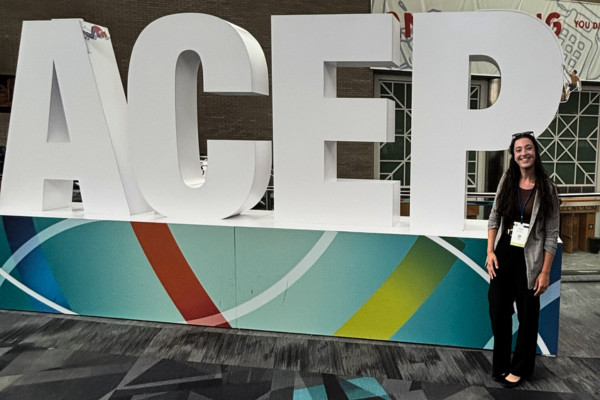 During her third year of medical school, Larissa Dean worked on a project analyzing YouTube videos about alcohol consumption, examining trends in both the comments and the types of videos posted.
“I learned of the collaborative efforts needed to put together a research project. It is amazing to see an idea come to reality when several people work together to make it happen,” she said.
Dean presented her findings at the American College of Emergency Physicians conference in Salt Lake City this past September. “It was my first time going to a conference of that magnitude. It was exciting to hear about the different ways the field of emergency medicine is progressing.”
As she moves closer to becoming a physician, Dean says the experience has shaped the kind of doctor she hopes to be. “I want to foster a collaborative learning environment in the future and contribute to the growing field of emergency medicine.” 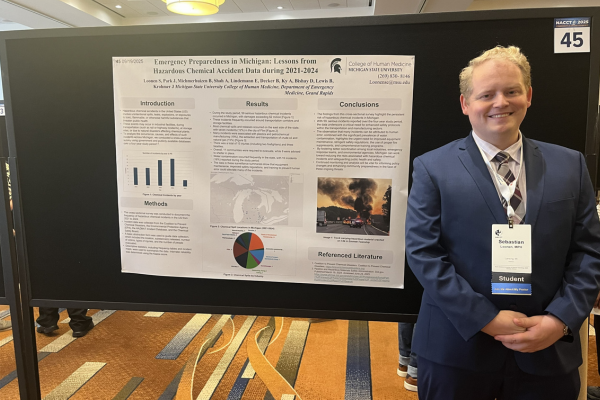 Third-year student Sebastian Loonen has worked on multiple projects through the program. He took the lead role on analyzing chemical spills in Michigan from 2021 to 2024 and presented his findings at the North American Congress of Clinical Toxicology in Chicago.
“Here I met many people in the field of toxicology who were interested in our methodology of the study. I met wonderful doctors from across the country and connected with our Michigan colleagues who offered to be mentors for toxicology specifically.”
Loonen also worked on a project analyzing and scoring media surrounding erotic asphyxiation, which he hopes to present at a conference in February.
For his graduation research requirement, he is studying the burden on Lansing-area emergency departments during Michigan State University home football games.
“Through this research experience, I have found the extreme breadth that emergency medicine research can contain. With this intense variety, I have been able to look at various subjects that are not connected but all come through the ER” he said. “It’s been nice to see the iterative nature of research and how one study can create further studies on similar topics.”
Medical students aren’t the only ones who benefit from these research efforts.  “Having many students engaged in clinical research propels academic output, drives reputation, and supports educational missions,” said Jeffery Jones, MD, associate chair for research for the Department of Emergency Medicine.
Jones has mentored students in research since 1990 and witnessed the program’s growth come full circle. The fathers of two current research students worked with Jones on research projects during their residencies.
“Personally, extensive student involvement enriches my teaching and provides deep personal and professional satisfaction,” Jones said.
Over the years, Jones has formed a strong partnership with Emergency Care Specialists to provide research funding and compensation for faculty mentors. The program has grown beyond just MSU medical students and now provides research opportunities to other health professions students at Grand Valley State University, Wayne State University and Central Michigan University.
By Nadija Kadunic | Media Contact Emily Linnert