

Become a Spartan M.D.
Community-Based. Mission-Focused.
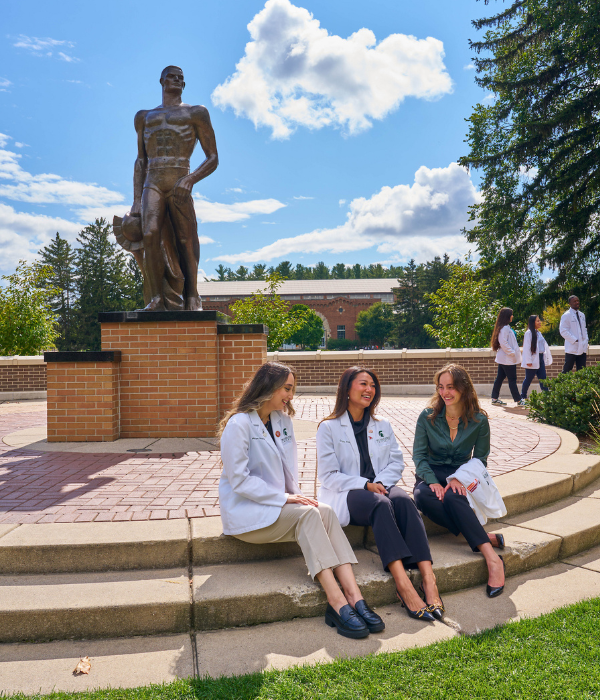
At MSU College of Human Medicine, we are committed to educating the next generation of physicians and scholars to lead with excellence and compassion. We advance health equity at home and abroad by promoting the dignity and inclusion of all people and responding to the needs of the medically underserved. With students training at eight community campuses and dozens of clinics across the state, we are the Michigan State of Medicine.
Degree Programs
Since 1964, MSU College of Human Medicine has been training students to become exemplary physicians and scholars who feel called to serve their community by providing compassionate care for all. First and second year students train in either East Lansing, on the MSU campus, or in Grand Rapids, at the Secchia Center. After two years of training, students join a community campus for their third and fourth years, rotating in any of nine primary teaching hospitals and 57 community hospitals across the state of Michigan.
Graduates of our MD program successfully match into residency training programs in all types of specialties and practice areas across the nation. See where Spartan MDs have matched!
Our Alumni: 6,599 Spartan MDs and counting!
The MD/PhD program combines medical (MD) and graduate (PhD) training with the goal of educating and training the next generation of leaders in biomedical research and academic medicine.
Our MD/PhD program has two options:
MSU MD/PhD Program
Students earn an MD degree from the College of Human Medicine and a PhD from the MSU Graduate School.
VAI-CHM MD/PhD Program
Student earns an MD degree from the College of Human Medicine and a PhD in Molecular and Cellular Biology through the Van Andel Institute Graduate School (The Graduate School). Students receive financial assistance through The Graduate School and is typically directed through a graduate fellowship.
Physicians diagnose and treat human disease, yet they also engage in the business of health care. Whether your future includes hospital administration, owning and operating a private practice, or other forms of healthcare leadership, having a background in business can ensure you have the skills necessary to deliver high quality care to patients.
In partnership with MSU’s Broad College of Business, the College of Human Medicine offers students the opportunity to earn a dual degree in medicine and business administration (MD/MBA). The MBA is a combined classroom and online program consisting of 61 credits that includes 31 credits of core MBA courses; 18 credits of concentration coursework in management, strategy and leadership; and 12 credits of medical school transfer credits. The expectation is for students to complete both degree programs in five years.
Applicants must apply to both the College of Human Medicine and Broad College of Business. The applicant will be evaluated independently by both colleges’ admissions committees. If accepted into both programs, the student’s curriculum will be set up as seen below.
MD/OMFS Program Partnership (Henry Ford Health)
Michigan State University College of Human Medicine partners with Henry Ford Health to support a combined Doctor of Medicine (MD) degree and Oral and Maxillofacial Surgery (OMFS) residency program for individuals who have already completed a Doctor of Dental Surgery (DDS) degree.
Students are enrolled in the MD program at MSU College of Human Medicine and begin their training on the East Lansing campus, where they complete three semesters of foundational medical education. Prior to transitioning to Henry Ford Health for clinical training, students are required to successfully complete the USMLE Step 1 examination, demonstrating readiness for the next phase of medical and surgical education.
Following this milestone, trainees move to Henry Ford Health for their core clinical clerkships (MD program) and residency-based surgical training. The program provides comprehensive exposure to the full scope of oral and maxillofacial surgery within a high-volume, tertiary care environment. Training occurs primarily at Henry Ford Hospital and includes interdisciplinary collaboration across specialties such as trauma, anesthesia, ENT, neurosurgery, and general surgery, preparing residents to manage complex patient populations.
This integrated curriculum combines medical education, surgical training, and specialty-specific experience to develop skilled, ethical, and adaptable surgeons equipped for leadership in the field.
For additional information about the program structure and curriculum, please visit:
Contact Information
For questions about the MD/OMFS program, please contact Christina Hines, Residency Program Coordinator, at chines6@hfhs.orgThe Charles Stewart Mott Department of Public Health at MSU College of Human Medicine offers students an opportunity to earn a Master of Public Health (MPH) degree. The degree program includes a 100% online curriculum with three concentrations customizable to your interests: Generalist, Rural Public Health, Public Health Data Management and Analytics.
Applicants must apply through the Schools of Public Health Application Service (SOPHAS). Please visit the Master of Public Health webpage for information.
Certificate Programs

Through unique certificate programs, medical students can enhance their learning experience and develop practical skills leading into residency.
- Leadership in Community and Public Health (LCPH)
Leadership in Community and Public Health (LCPH)
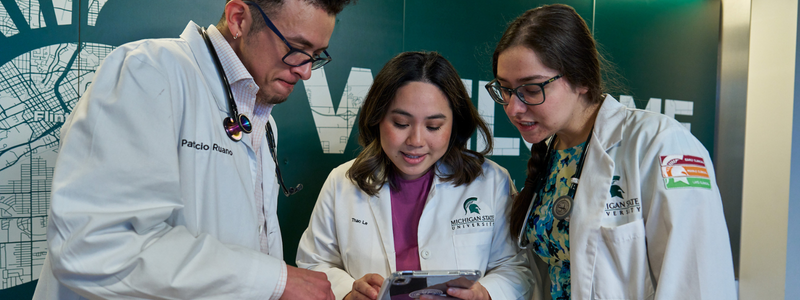
The Leadership in Community and Public Health program, based in Flint, Michigan, aims to provide medical students with the opportunity to work with and learn from underserved and vulnerable populations. In addition to traditional clinical medical education, LCPH focuses on the acquisition of knowledge, skills, and attitudes necessary to address the varied medical needs of urban, rural, and international underserved populations.
- Leadership in Rural Medicine (LRM)
Leadership in Rural Medicine (LRM)
For almost 50 years the Leadership in Rural Medicine Programs have trained doctors in underserved rural communities across Michigan. The programs educate rurally-minded medical students in small towns and clinical sites statewide to encourage and empower students to serve these populations in their careers as physicians.
Other Admission Pathways
With a mission to serve all people, we have developed admission pathways that expand access to medical education and support future physicians committed to serving underserved communities and regions with the greatest healthcare needs.
- Advanced Baccalaureate Learning Experience (ABLE)
Advanced Baccalaureate Learning Experience (ABLE)
The Advanced Baccalaureate Learning Experience (ABLE) is a one-year postbaccalaureate pathway designed for applicants from disadvantaged backgrounds who demonstrate strong potential for success in medical school but may benefit from additional academic preparation prior to matriculation.
ABLE is not a traditional postbaccalaureate program. Rather, it serves as a conditional pathway to admission to the MSU College of Human Medicine M.D. program.
Learn more about the ABLE program
- Early Assurance Program (EAP)
Early Assurance Program (EAP)
The MSU College of Human Medicine has partnered with colleges and universities with ties to our clinical community campus sites to provide early assurance of medical school admission and enriched experiences for undergraduate students interested in becoming physicians in an underserved region or with an underserved population.
Learn more about the EAP program
- Pre-Medical Pathway Programs
Pre-Medical Pathway Programs
Michigan State University College of Human Medicine offers a range of pre-medical pathway programs designed for undergraduate students who are exploring a career in medicine and seeking to strengthen their preparation for the medical school application process.
These programs provide structured opportunities for students to learn more about the medical profession, assess their readiness for a career in medicine, and build the experiential and professional competencies needed to become competitive applicants.
See all pre-medical pathway programs
MD Admission Requirements
MSU College of Human Medicine uses a mission-aligned selection process to identify candidates for our MD program. We admit individuals who demonstrate academic excellence; commitment to service and community; personal characteristics and competencies consistent with the profession of medicine; and potential to advance the mission of our college.
-
General
Each MSU College of Human Medicine applicant must:
- Be a United States or Canadian citizen; or have a Permanent Resident or Deferred Action for Childhood Arrivals (DACA) status within the United States
- Have completed at least 90 hours of college course work at an accredited U.S. or Canadian institution; a bachelor’s degree must be conferred prior to matriculation
- Have completed all prerequisite coursework
- Have taken the Medical College Admissions Test (MCAT)
- Have a valid U.S. or Canadian driver’s license and reliable vehicle (upon matriculation)
-
Technical Standards
Candidates for an MD Degree must possess certain abilities and skills. MSU College of Human Medicine has established a set of technical standards necessary for medical students to achieve the knowledge, skills, and levels of competency for medical education and graduation. Students must attest to meeting the technical standards at the time of interview, matriculation, and on an annual basis thereafter.
Reasonable technical accommodation(s) can be made in some circumstances; however, the student must be able to perform in a reasonably independent manner with accommodation(s). If you believe you may need accommodation(s), please contact the MSU Resource Center for Persons with Disabilities
Read MSU CHM’s Technical Standards -
Prerequisite Coursework
All prerequisite coursework must be completed at an accredited college or university in the United States or Canada. Applicants who complete prerequisite courses at community colleges are encouraged to demonstrate competency by completing higher level courses in related subjects at an accredited U.S. or Canadian four-year institution.
A grade of C+ (2.3 on a 4-point scale) or higher must be achieved in all prerequisite courses to meet minimum academic standards.
The following courses are required for admission:
- biochemistry
- biology (upper level, e., 300 level or higher)
- physics (two semesters)
The following courses/subjects are strongly recommended:
Behavioral Sciences Humanities Life & Physical Sciences Mathematics - Anthropology
- Psychology
- Sociology
- Ethics (bioethics)
- History
- Languages
- Philosophy
- Anatomy
- Bioinformatics
- Genetics
- Immunology
- Microbiology
- Neuroscience
- Physiology
- Algebra
- Data analysis and processing
- Statistics
-
Letters of Evaluation
Applicants are required to submit a minimum of three letters of evaluation (maximum of four). Letters of evaluation should be written by individuals who know you well and can objectively assess your academic readiness for medical school, personal characteristics, and/or ability to engage with others in academic, clinical, or community-based settings. MSU College of Human Medicine requires one letter to be written by a science course instructor. While not required, applicants are encouraged to obtain a letter from a supervisor in a clinical setting. Letters from family members and/or friends are discouraged.
All letters should be written on letterheads, signed, and submitted through the AMCAS Letters Service. Instructions for submitting letters via AMCAS are provided within the AMCAS application. Do not send any letters directly to MSU College of Human Medicine.
Committee Letters & Letter Packets
A committee letter, authored by a pre-health committee or pre-health advisor, and intended to represent your institution's evaluation of you, counts as one letter entry. A letter entry may consist of more than one letter. If the committee letter is accompanied by at least two of the individual letters it references, one letter entry will fulfill our requirement. However, if your committee letter is not accompanied by a minimum of two of the individual letters referenced in it, you will need to submit two more individual letters to meet our minimum requirement.
A letter packet is assembled and distributed by your school. It may or may not include a cover letter from your pre-health advisor or committee, but it does not include a committee evaluation. A letter packet counts as one letter entry. If the letter packet contains at least three individual letters, it will fulfill our requirements. However, if the letter packet includes fewer than three individual letters, you will need to submit additional individual letters to meet our minimum requirement.
-
Situational Judgement Test
Applicants are required to take one situational judgement test, either the Casper Test (Altus Suite) or the AAMC PREview Exam. Please visit the Altus Assessments and/or AAMC websites for registration and available testing dates.
NOTE: Applicants to our MD/PhD dual degree program may have a different testing deadline than our MD applicants. All applicants are advised to consult the list of Important Dates & Deadlines for the current application cycle. Applicants who test after the listed deadline will not be considered.
-
Secondary Application
Applicants who meet our residency and minimum academic standards will be invited to submit a secondary application. Those whose academic metrics are below our minimum standards will be screened for mission-alignment and achievement and may be sent a secondary application.
Minimum Academic Standards
- Undergraduate BCPM GPA ≥ 2.5, or
- Cumulative post-baccalaureate BCPM of 3.0 with at least 20 credit hours in the sciences
- Cumulative graduate BCPM of 3.0 with at least 20 credit hours in the sciences
- MCAT Total Score ≥ 498 (approximately 40th percentile)
Tips for Success:- Prioritize submission of secondary applications to the schools you are most interested in. Ideally, you should submit your secondary application responses within two weeks.
- Familiarize yourself with each school’s mission and only apply to schools with which your personal values and mission are well-aligned.
Our mission statement: Michigan State University College of Human Medicine is committed to educating exemplary physicians and scholars, discovering and disseminating new knowledge, and providing service at home and abroad. We enhance our communities by providing outstanding primary and specialty care, promoting the dignity and inclusion of all people, and responding to the needs of the medically underserved.- Secondary Application Essay Prompts | 2027 Admission Cycle
1. How have your most meaningful experiences shaped what you envision doing in medicine 15 years from now? Describe one specific future accomplishment that would define your career’s success up to that point in time. (Please limit your response to 400 words or less.)
2. How have your personal experiences with, or observations of, systemic inequities shaped your perspective? Moving beyond generalities, describe how this perspective will uniquely influence your approach to patient care and your role in addressing health disparities as a future physician. (Please limit your response to 400 words or less.)
3. Each year, we review thousands of applications. Beyond what is in your primary application, what do you want the Admissions Committee to know about you as it relates to your fit for MSU CHM’s community-based mission? If you are an out-of-state applicant, we encourage you to address your interest in training and potentially practicing in Michigan. (Please limit your response to 400 words or less.)
- Undergraduate BCPM GPA ≥ 2.5, or
Important Program Dates and Deadlines
-
MD Program
September 12 Last acceptable MCAT date October 15 Last acceptable AAMC PREview Exam date October 15 AMCAS Application Due November 12 Last acceptable Casper Test date November 30 Secondary Application and Letters of Evaluation Due February 19 Accepted applicants should engage with AMCAS Choose Your Medical School Tool and select the school at which they “Plan to Enroll” April 30 Accepted applicants must engage with AMCAS Choose Your Medical School Tool and select the school at which they “Commit to Enroll” Last day to receive a refund of your deposit July 13 MSU College of Human Medicine “Commit to Enroll” deadline -
MD/PhD Program
August 15 Last acceptable MCAT date August 13 Last acceptable Casper Test date August 25 Last acceptable AAMC PREview Exam date September 1 AMCAS Application Due October 1 Secondary Application and Letters of Evaluation Due February 19 Accepted applicants should engage with AMCAS Choose Your Medical School Tool and select the school at which they “Plan to Enroll” April 30 Accepted applicants must engage with AMCAS Choose Your Medical School Tool and select the school at which they “Commit to Enroll” Last day to receive a refund of your deposit July 13 MSU College of Human Medicine “Commit to Enroll” deadline -
MD/OMS Program
October 1 Last acceptable Casper Test date October 15 Last acceptable AAMC PREview Exam date November 1 Secondary Application and Letters of Evaluation Due November 12 Last acceptable Casper Test date January 20, 2027 National Matching Services (NMS) Oral & Maxillofacial Surgery (OMS) Match

Why Students Choose MSU
-

A Statewide Medical School
As a community-based medical school, the College of Human Medicine is uniquely positioned to provide students with comprehensive training in clinical settings across the state of Michigan that most closely parallel the environment in which many physicians typically practice. Through the Shared Discovery Curriculum, students enter clinical settings and become meaningful contributors to patient care early in their first year of medical school.
-
To Achieve What Others Say is Impossible
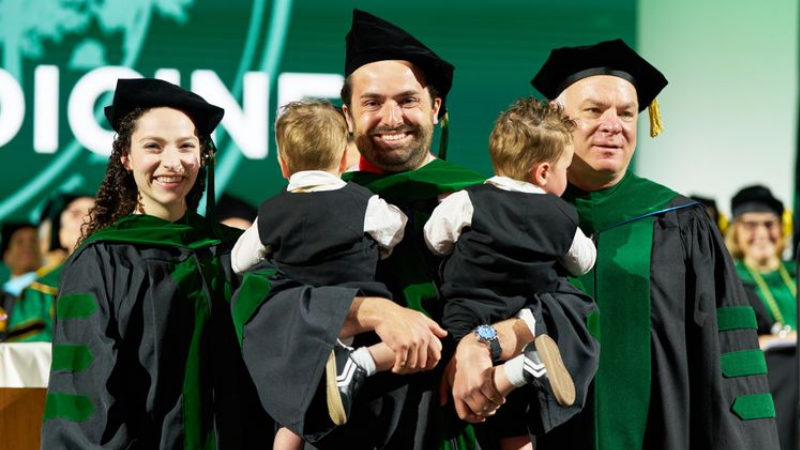
With the support of the College of Human Medicine community, students achieve what's often considered unattainable at other medical schools: raising a family, writing a book, or running a medtech startup. What sets us apart is the support and resources available to non-traditional students.
-

A Focus on Service Learning and Health Equity
Our mission -- caring for the underserved and addressing social determinants of health -- is reflected in the College of Human Medicine's educational approach, the type of applicants who become medical students here, and the ways our Spartans serve their communities throughout medical school.
-
To Become a Rural Spartan MD
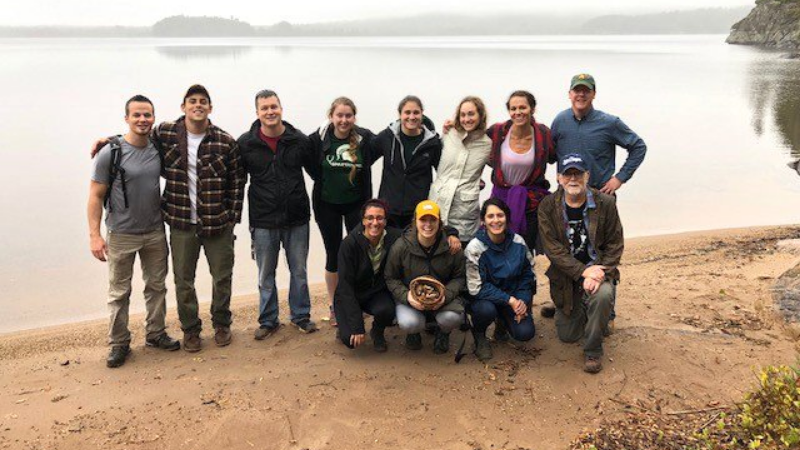
For more than 60 years, the College of Human Medicine has been a leader in training doctors in rural communities across Michigan. Medical students are empowered to care for underserved populations by training in small towns and clinical sites in Traverse City, Midland and or the Upper Peninsula.
Student Testimonials
 “I have always wanted to make a difference in the world through service. I am passionate about advocating for children in underserved communities and amplifying marginalized voices to advance health equity. I chose MSU College of Human Medicine because of the university’s emphasis on community-focused medicine and public health.”
- Simi Neeluru, Class of 2028
 "I am so grateful for the Flint Campus for nurturing that sense of purpose for me. I could have easily become burnt out after experiencing what it was like to work in the American health care system. But the spirit of community and collaboration is so fundamental to the Flint community that I never lost track of my mission."
- Brandon Leung, Class of 2025
 “What I find so remarkable about my time at the College of Human Medicine is that I learned not only how to be a doctor, but also an advocate for vulnerable populations on a larger scale. I think our curriculum really instills within us the social impact that medicine and healthcare can have on our communities that we serve.”
- Dennis Boynton, Class of 2025
Financing Your Medical Education
Financial Aid Information
The MSU Office of Financial Aid provides information regarding financial aid and loans for College of Human Medicine students.
All questions about your financial aid packet should be directed to the Office of Financial Aid via email (ofamed@msu.edu) or by phone (517) 353-2401.
-
Financial Aid Information
The MSU Office of Financial Aid (OFA) and the College of Human Medicine partner to provide a range of financial aid and financial well-being resources for CHM students. With a specialized Medical Advising Team, OFA provides advising uniquely attuned to the financial aid needs of medical students. The College’s Director of Student Services, part of the College’s Office of Student Affairs and Services (OSAS), serves as the liaison to OFA and to other financial well-being resources. This partnership gives students the answers and responsiveness needed when they have financial aid questions or face unexpected financial challenges.
-
Financial Aid Resources
The first step to receiving financial aid assistance is to submit the Free Application for Federal Student Aid (FAFSA) form online. MSU FAFSA Code: 002290
The Association for American Medical Colleges (AAMC) Financial Information, Resources, Services, and Tools (FIRST) program provides guidance about paying for medical school, managing money, and successfully repaying your student loans.
-
Financial Aid Contact
Questions about financial can be directed to the Medical Advising Team within the Office of Financial Aid.
- Email: ofamed@msu.edu
- Phone: (517) 353-2401
Mailing Address
Office of Financial Aid
Student Services Building
556 E. Circle Drive, Room 252
Michigan State University
East Lansing, MI 48824 -
Office Locations & Hours
Appointments are required for in-person advising.
Times are available Monday – Friday, 9:00 a.m. – 4:30 p.m. at:
- 252 Student Services Building, East Lansing
- 380 Secchia Center, Grand Rapids
Scholarship Opportunities
Scholarship support through the Office of Admissions is made possible by both institutional commitment and the extraordinary generosity of our donors. These contributions directly impact our students—reducing financial barriers and empowering them to pursue careers in medicine. We are deeply appreciative of our donors, whose partnership helps advance our mission and invest in the next generation of physicians.
-
Donor-Funded Scholarship Awards for Entering Students
The Office of Admissions administers the following donor-funded scholarships for entering students. Scholarship awards vary in amount. Accepted applicants will receive an invitation to apply in late winter or early spring prior to matriculation.
- Alice Dunne Chambliss Endowed Scholarship
- Alida Sherwood Larsen Endowed Memorial Scholarship
- Alonso S. Collar Memorial Scholarship
- Anne Murphy Janca Endowed Scholarship
- Berkompas Human Medicine Scholarship Endowment (coming soon)
- Bhanusali Innovation Scholars
- Bright Future Medical Education Scholarship
- Chan Family Medical Education Endowed Scholarship
- Chan Family Medical Education Scholarship in honor of Women in Medicine
- Charles and Lois Thompson and Alexander and Irene Weiss Endowed Scholarship
- College of Human Medicine Class of 1972 Endowed Scholarship Fund (coming soon)
- College of Human Medicine Dean’s Endowed Scholarship
- College of Human Medicine Endowed Competitive Medical Scholarship
- Daniel and Debra Edson Endowed Scholarship
- Dr. Alan Neiberg Scholarship in Human Medicine
- Dr. Alan D. Neiberg Expendable Scholarship in Human Medicine
- Dr. Alan Neiberg and Judith A. Neiberg Trust Endowed Scholarship in Human Medicine
- Dr. Barbara Fogle Mercer Endowed Scholarship for Medical Education
- Dr. David A. and Marilyn D. Milko Endowed Medical Education Scholarship
- Dr. Harry D. Brickley Endowed Scholarship in Human Medicine
- Dr. Jack Jones Spartan Cornerstone Scholarship
- Dr. Thomas R. Kaye Memorial Scholarship Fund (coming soon)
- Dr. Khan Nedd and Liza Nedd Family Endowed Scholarship
- Green Endowed Medical Scholarship
- Ida and Theodore Goode Endowed Competitive Scholarship
- Julius Barbour Memorial Scholarship
- Kathryn and Steven Bandstra Scholarship for Rural Community Health
- Khaghany Family Endowed Scholarship
- Madala Family Scholarship
- Maples/Kampfschulte Family Spartan Cornerstone Scholarship
- Mashkiki Endowed Scholarship in Human Medicine
- Meaningful Journeys Scholarship
- Michael Bowman, M.D. Endowed Scholarship in Human Medicine
- Michigan Great Lakes Opportunity Endowed Scholarship
- Michigan State University College of Human Medicine for the Dr. Phillip and Janis Van Antwerp Potter Endowed Fund
- Ned Fawaz Arab-American Community Health Endowed Scholarship in Human Medicine
- Norman and Kristina Beachamp Merit Scholarship
- Saginaw Medical Excellence Scholarship
- Sinai Medical Staff Foundation Endowed Scholarship
- Spartan Cornerstone Challenge Endowed Scholarship in Human Medicine
- Steensma Family Endowed Scholarship
- William H. and Helen Elias Morgan Scholarship
- Williams Human Medicine Scholarship
- Yamamoto Family Endowed Scholarship for Medical Students
In addition to these scholarships awarded to entering students, the College offers many additional donor-funded scholarships to support students as they progress through the medical education program. These scholarships are awarded annually through an application process administered by the Office of Student Affairs & Services.
-
Mission Excellence Scholarships
The Mission Excellence Scholarship is awarded to select entering students who demonstrate strong potential to advance the College’s mission. Recipients are selected through holistic review of their application materials—no separate application is required—based on academic achievement, financial need, and meaningful engagement in activities that reflect a commitment to addressing health disparities and/or serving in physician shortage areas. Each award provides $20,000 for the M1 year and is renewable for a second year, for a total potential award of $40,000, contingent upon good academic standing.
-
Dean’s Scholars Program
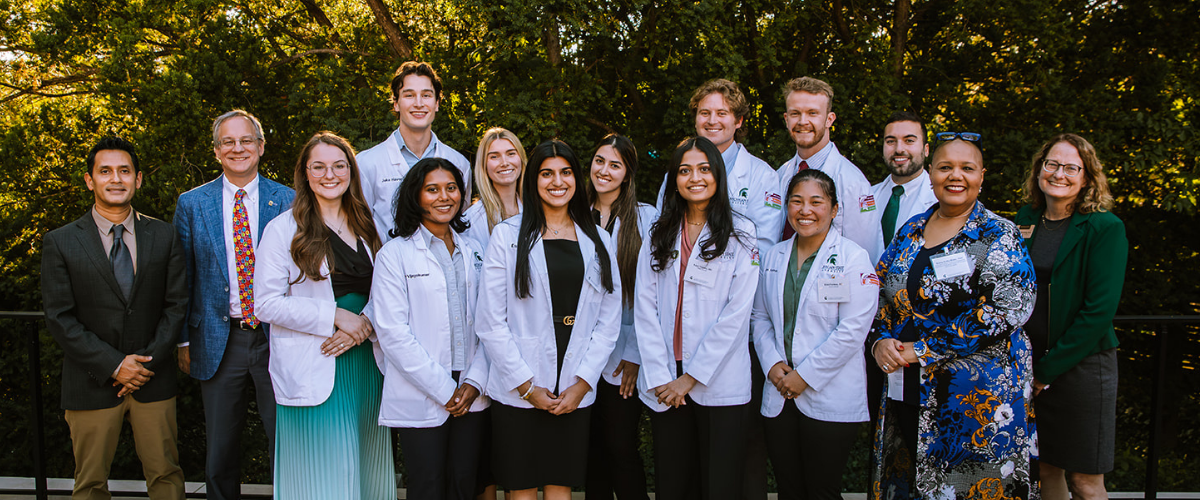
The Dean’s Scholars Program at MSU College of Human Medicine aims to recognize and support outstanding medical students dedicated to advancing health equity. As a community-based medical school, our students are uniquely positioned to engage with the multitude of patient populations in Michigan and learn to deliver care that will improve the health of all. We envision our scholars as future healthcare leaders who excel in patient care, research, and community service. By fostering leadership, a commitment to health justice, and a passion for public service, we aim to shape exemplary physicians who will transform healthcare and improve access for all.
The Dean’s Scholars Program is a 4-year program that includes curriculum enhancement opportunities for leadership development, specialized mentorship, scholarly research, and community engagement. Dean’s Scholars Program students also receive a full tuition scholarship at Michigan residency rates for a total of eleven (11) semesters of medical school.
Candidates for the Dean’s Scholars Program are selected during the admissions process and are invited to interview for the program. Three Dean’s Scholars are identified each year. Qualified candidates are those who have engaged in coursework and activities that demonstrate a commitment to addressing healthcare disparities and improving health outcomes; have leadership experience and demonstrate potential to grow as a leader; have exposure and experience working with different people, whether through their life experience or chosen activities; and have demonstrated strong academic performance in the classroom and on the MCAT.
-
Bhanusali Innovation Scholars Program
The Bhanusali Innovation Scholars Program was established by Dr. Dhaval Bhanusali, a board-certified dermatologist, researcher, and digital health entrepreneur based in New York City. A proud Spartan, Dr. Bhanusali has built a career at the intersection of medicine, innovation, and impact—launching ventures like Skin Medicinals, Aire Health, and ELM Biosciences while teaching at Mount Sinai Hospital. The scholarship and program opportunity is for students who share his entrepreneurial spirit and mindset. In partnership with the MSU Burgess Institute for Entrepreneurship & Innovation, this opportunity surrounds select MSU College of Human students with a world-class medical education and entrepreneurial ecosystem to help them transform their healthcare ideas into ventures that change lives.
The Bhanusali Innovation Scholars Program includes:
- structured programming
- one-on-one venture coaching
- startup funding pathways
- mentorship from Dr. Bhanusali and other entrepreneurial leaders
- full tuition scholarship
- additional funds to be used towards ventures
Interested applicants apply for the Bhanusali Innovation Scholars Program when submitting the MSU College of Human Medicine secondary application by completing a series of essays. Essay responses will be reviewed by CHM and Burgess Institute faculty and staff and select candidates will be invited to interviews. Interviews occur in December and January.
- About the Donor
 Dhaval Bhanusali, MD, is a 2005 alum of the Michigan State University College of Natural Science and Honors College. After being admitted to medical school at 17 years old, he graduated from the College of Human Medicine in 2010. Dr. Bhanusali completed his residency at Mount Sinai, where he now serves on the faculty. He received the MSU Young Alumni Award in 2019. Dr. Bhanusali has been named one of Allure’s A-List for people changing the beauty world, a New York Times Superdoctor, the American Academy of Dermatology - Patient Care Hero of the Year, and a Crain’s NY Top 25 Healthcare innovator.
 In the News: Spartan MD Invests in the Next Generation of Physician-Innovators with Landmark Scholarship Gift (November 11, 2025)
X
![]()
X
![]()