

New Program Boosts Primary-Care Research in Michigan
February 3, 2026
Michigan State University College of Human Medicine launches Primary Care Research Collaborative to address health needs of Michiganders
When something goes wrong in our bodies, most Americans turn to their primary care physicians. Family medicine and primary care offices function as the entry point to the rest of the American health care system, not only diagnosing and treating acute illnesses but also helping to manage chronic diseases and life-threatening conditions throughout the lifespan. Family doctors are a trusted resource in an increasingly complex medical landscape.
Why, then, is only 0.34% of federal research dollars allocated to primary care research?
“Half of outpatient care is in primary care in this country,” said Julie Phillips, MD, MPH, HALM, chair of the College of Human Medicine’s Department of Family Medicine. “The gap between volume of care and investment of research resources is profound.”

To remedy that, MSU College of Human Medicine Department of Family Medicine has established a new Primary Care Research Collaborative (PCRC). It is one of only two active practice-based research networks in Michigan. One of the collaborative’s first initiatives is the development a new physician research training fellowship program.
Yasi Zamani-Hank, PhD, MPH, is director of the PCRC, assistant professor in the Department of Family Medicine and an epidemiologist with a master’s in public health and a heart for primary care. She is leading the network’s “train the trainers” approach and facilitates ongoing, community-initiated research to address gaps in clinical care and research capacity across the state.
“We are excited by the enthusiasm, involvement, and commitment we’ve seen from our community practices across the state,” said Zamani-Hank. “We are excited by this opportunity to support the research interests and needs of our community-based faculty, residents, and researchers.”
Developing the Next Generation of Primary Care Researchers
The new training fellowship is a 15-month-long intensive program for six physician research fellows, all faculty in six different residency programs across the state who play a significant role in mentoring residents in research and scholarship. The program will help fellows develop skills in study design, research methodology, writing for publication, research teaching, and curriculum development for residents.
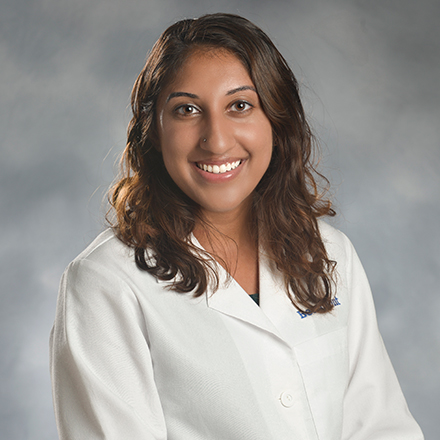 Gurbaksh Esch, MD, a College of Human Medicine alumnus and current participant in the PCRC fellowship, loves that she is connecting her research background with her heart for education. Esch is a board-certified pediatrician serving the Flint community.
“The fellowship has been a great opportunity to learn more about foundations of research, development of skills to think of projects that would be ideal for learners to participate in, and to understand how to teach learners and help them feel comfortable,” Esch said. “There is so much to learn in the primary care setting. Patients come and see their primary care physician regularly and develop a longitudinal relationship, which can overall have an impact on their health and well-being.”
A Community Approach to Primary Care Research
Practice-based research networks (PBRNs) have been in existence for decades in the United States and have existed in various iterations within the MSU College of Human Medicine over the years. But the current PCRC uses the proven model of a PBRN with a few unique twists. The emphasis on promoting research capacity in community-based residency programs and teaching residents how to conduct research while they are relatively new to the practice is a “fun model that has added some richness,” according to Phillips. The network stretches over the entire state and reaches a diverse group of community sites. “We are trying to lean into that diversity,” Phillips noted, adding that it’s important to let each site identify its own specific research needs.
 Zamani-Hank explains that people can think of the PCRC as having two arms: a research arm that provides support services for researchers interested in primary care, and an education and training arm for physicians who are developing research expertise. The PCRC is funded through the American Board of Family Medicine Foundation, MSU College of Human Medicine and the Department of Family Medicine, and is registered on the Agency for Healthcare Research and Quality (AHRQ) National PBRN Registry. Having strong institutional support has been key to the success of the PCRC and highlights the importance of the work, she noted.
“Primary care research is critical to population health and addressing health disparities,” said Zamani-Hank. “Primary care practices serve a broad and diverse patient population, from birth to end-of-life, which offers a unique opportunity to incorporate lifecourse models and produce highly generalizable research.
“Primary care is where the majority of patient health needs are cared for and where most preventive care is implemented. And, importantly, research conducted in practice settings also allows for more rapid translation and implementation of findings to clinical practice. This offers a unique opportunity for primary care research to improve the health of not just individual patients, but of entire communities,” said Zamani-Hank.
Statewide Support for Research
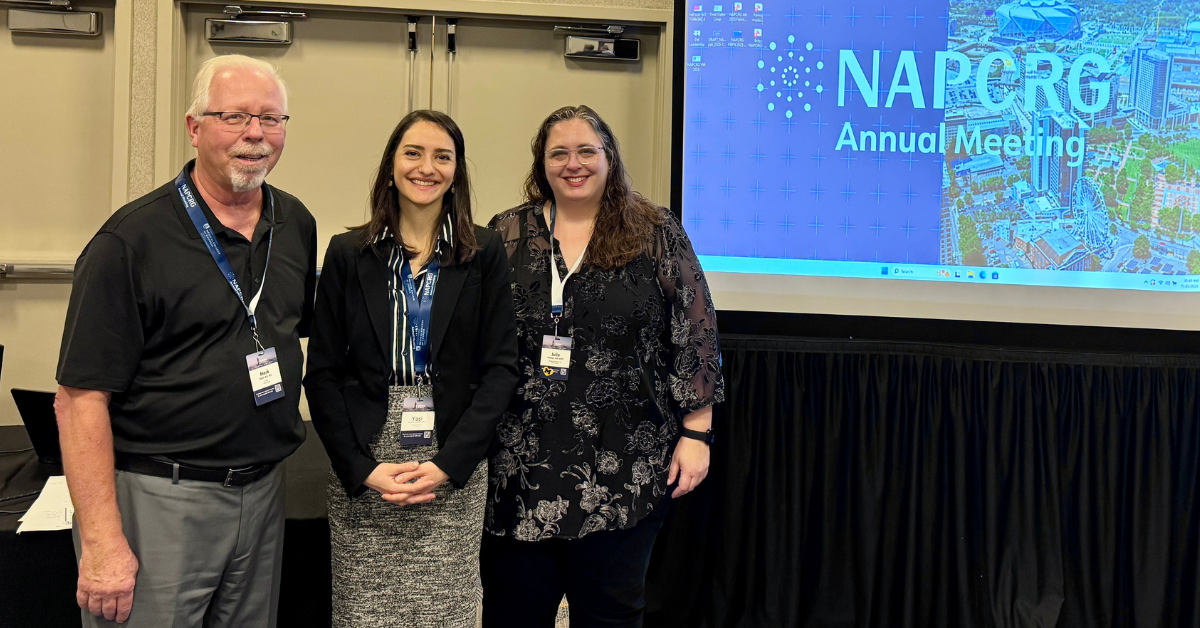
MSU Primary Care Research Collaborative Team Members Mark Ebell, MD, MS, Yasi Zamani-Hank, PhD, MPH, and Julie Phillips, MD, MPH, HALM at the North American Primary Care Research Group Annual Meeting in November 2025.
While there is a heavy focus on community-initiated research proposals, it is important to note that any researcher within or outside of the primary care space can submit a proposal to the PCRC for research support. The overall vision for the PCRC is to integrate primary care research with the broader research landscape to optimize patient care, community well-being, and public health. In the future, the PCRC plans to include pediatric and internal medicine practices as well.
“There is so much value in having practicing primary care physicians inform and participate in research. As much as we can, we make that dialogue tighter so that the practice informs the research,” said Phillips.
To learn more about the work happening throughout the PCRC, or to submit a research proposal, visit the PCRC homepage.
By Kayla Crum, RN | Media Contact: Emily Linnert